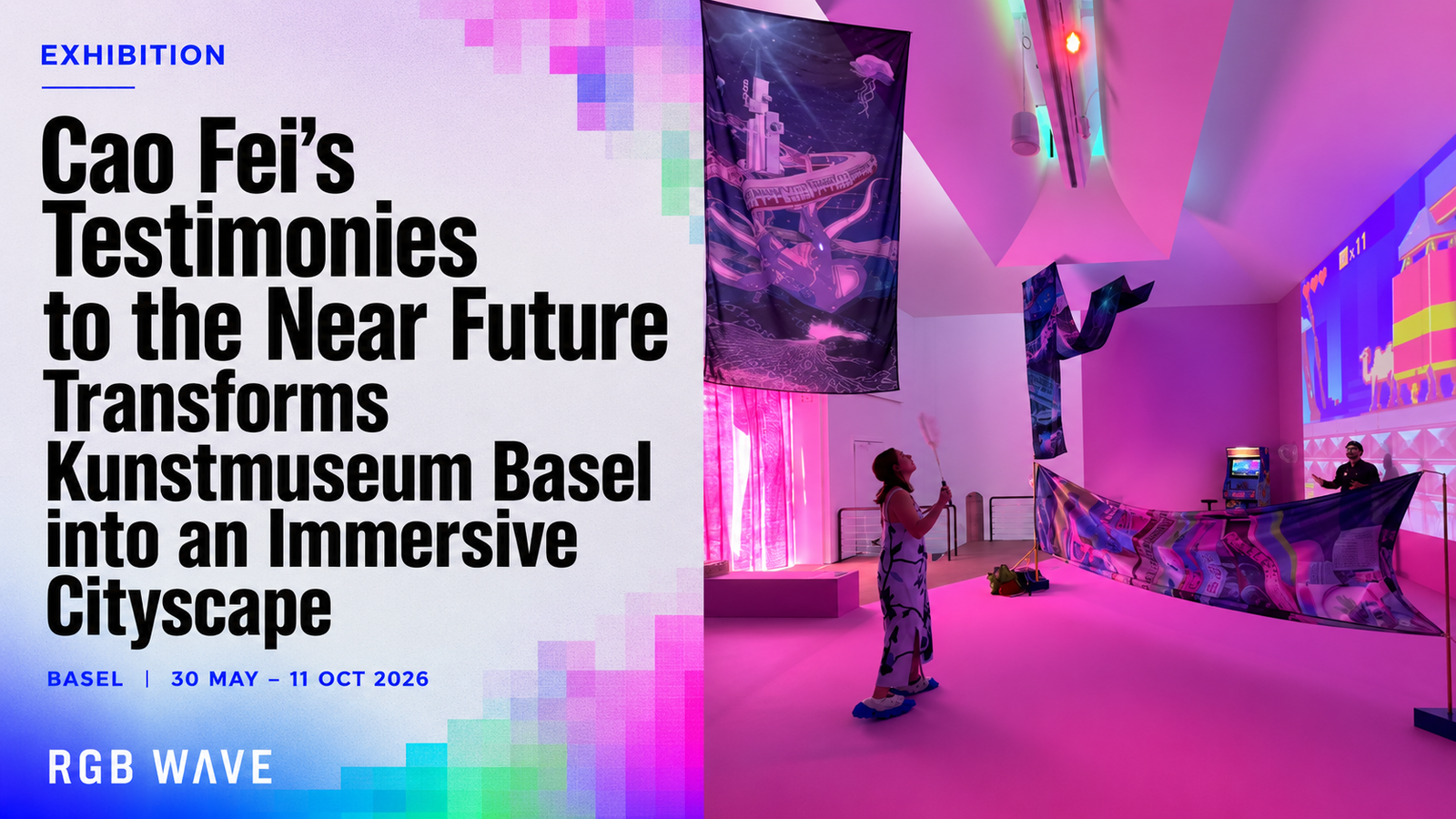
Testimonies to the Near Future brings together video, installation, photography, sculpture and digital environments in Cao Fei’s largest European retrospective to date.
Chinese artist Cao Fei is presenting Testimonies to the Near Future, her first solo exhibition in Switzerland and the largest retrospective of her work ever staged in Europe. On view from 30 May to 11 October 2026 at Kunstmuseum Basel | Gegenwart, the exhibition unfolds across four floors, transforming the museum into an immersive city-like environment where physical and digital realities overlap.
At a moment when contemporary culture is increasingly shaped by virtual experiences, networked identities and mediated memories, Cao Fei’s practice feels especially relevant. For more than two decades, the artist has explored the intersections of technology, urbanization, imagination and everyday life, creating works that examine how people navigate rapidly changing social and digital landscapes.
An immersive retrospective built as a living environment
Rather than presenting a conventional chronological survey, Testimonies to the Near Future operates as an experiential environment. Visitors move through interconnected spaces where video installations, photographs, sculptures and digital worlds coexist, creating a layered narrative about contemporary existence.
The exhibition’s cityscape structure mirrors many of the recurring themes in Cao Fei’s work: the collision between reality and fiction, the transformation of urban spaces, and the ways technology reshapes collective imagination. This approach positions the retrospective not only as a presentation of artworks but also as a spatial reflection on how contemporary life is experienced through screens, networks and virtual projections.
Play, memory and the aesthetics of participation
One of the exhibition’s most striking elements is a giant ball pit that invites visitors into an environment where play becomes a mechanism for reflection. The installation blurs distinctions between childhood memories, public participation and immersive art, encouraging audiences to engage physically rather than remain passive observers.
Experiential installations have become increasingly significant within contemporary visual culture, particularly in an era shaped by social media and image circulation. Yet Cao Fei’s work goes beyond spectacle. The playful environment functions as a conceptual space where memory, fantasy and social interaction intersect, highlighting how personal experiences are constantly reconstructed through cultural and technological frameworks.
Cao Fei and the digital imagination
Throughout her career, Cao Fei has investigated how emerging technologies influence identity and perception. Her projects frequently move between physical and virtual spaces, exploring online worlds, speculative futures and alternative social realities. This makes her work particularly relevant within ongoing conversations about digital culture and the evolution of visual storytelling.
At Kunstmuseum Basel, these concerns are brought together in a large-scale presentation that emphasizes the artist’s ability to merge cinematic narratives, installation practices and technological imagination. Visitors encounter works that reflect not only contemporary China but also broader global experiences shaped by connectivity, automation and the expanding influence of digital environments.
For readers interested in exploring similar intersections between art, technology and contemporary visual culture, RGB Wave regularly publishes more articles on art, technology and digital aesthetics that examine how images, environments and emerging media continue to shape cultural experience.
A portrait of the near future
Testimonies to the Near Future arrives at a time when the boundaries between physical and digital realities are becoming increasingly fluid. By bringing together immersive environments, participatory installations and technologically informed narratives, the exhibition offers a compelling framework for understanding how contemporary societies imagine the future.
More than a retrospective, the project functions as a reflection on the visual systems that organize contemporary life. Through memory, play, urban transformation and digital imagination, Cao Fei creates a space where visitors can experience the complexities of a world increasingly defined by the movement of images, data and collective dreams.