Les Demoiselles d’Avignon returns to the centre of debate as Henry Taylor’s reinterpretation exposes questions of African influence, cultural power and representation.
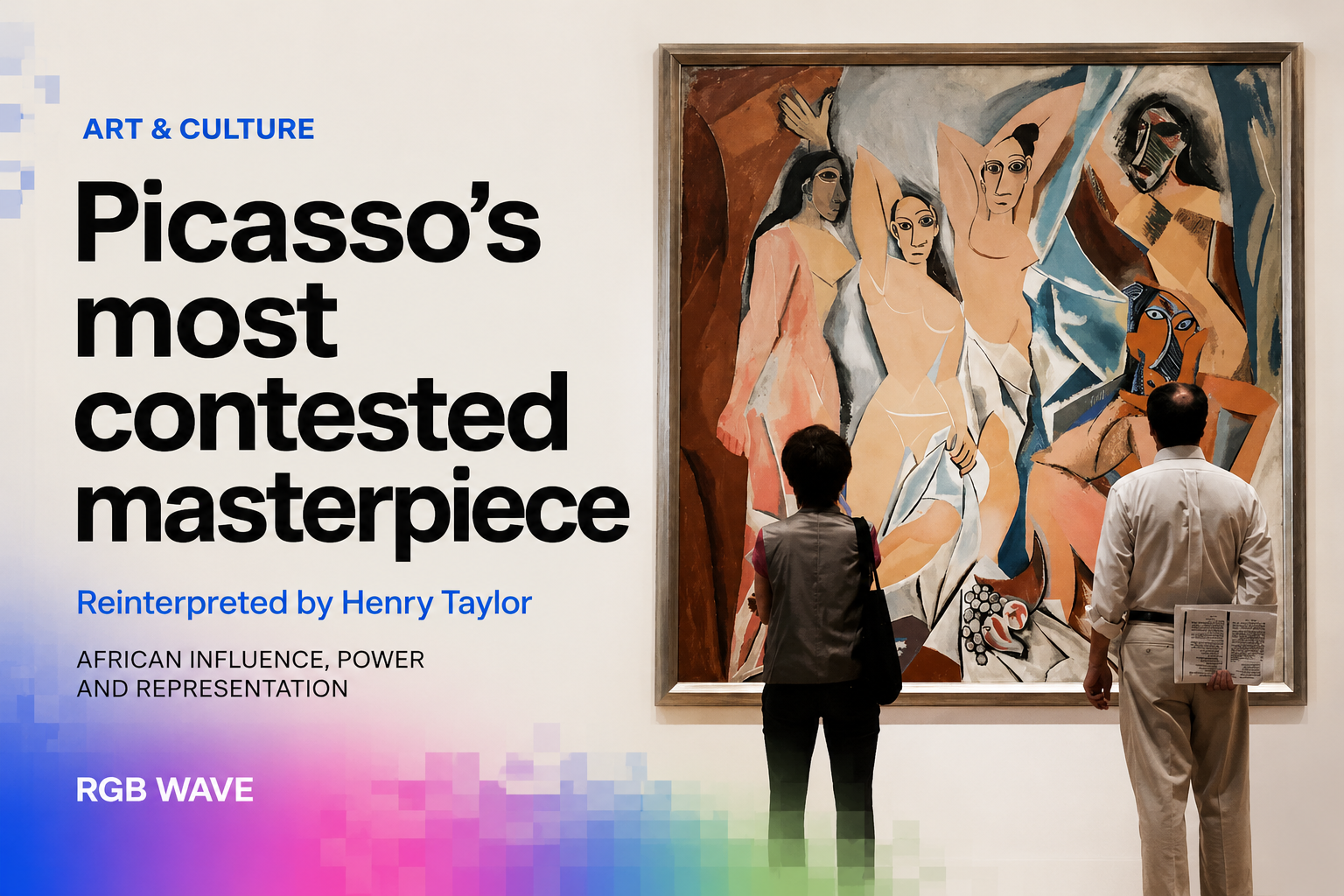
Les Demoiselles d’Avignon, painted by Pablo Picasso in 1907, remains one of the most influential and controversial images in modern art. More than a century after it shocked Picasso’s circle in Paris, the painting is again being reconsidered through the work of American artist Henry Taylor, whose reinterpretation is currently part of Henry Taylor. Where thoughts provoke at the Musée national Picasso-Paris.
The exhibition, on view from April 8 to September 6, 2026, presents Taylor as one of the major figures of contemporary American painting while continuing the museum’s exploration of Picasso’s reception in the American scene. In that context, Taylor’s 2007 painting From Congo to the Capitol, and black again does more than quote a canonical masterpiece. It reopens the historical, visual and political systems behind it.
A painting that broke the body and the picture plane
When Picasso first showed Les Demoiselles d’Avignon to a small group of artists and friends in 1907, the response was famously hostile. Its five nude figures, set in a Barcelona brothel, did not conform to the conventions of beauty, perspective or pictorial harmony. Their bodies appear fractured, angular and confrontational. The image does not invite passive viewing; it looks back.
Now in the collection of The Museum of Modern Art in New York, the work is widely considered a turning point in the development of modern art. Its radical compression of space, multiple viewpoints and geometric distortion helped open the path toward Cubism, a movement that dismantled traditional illusion and replaced it with fractured visual construction.
But the painting’s importance has never been only formal. Its power comes from the collision of desire, violence, primitivism, appropriation, sexuality and modernity. This is why Les Demoiselles d’Avignon continues to generate debate: it is both a breakthrough and a problem.
African influence and the problem of acknowledgement
One of the most contested aspects of Les Demoiselles d’Avignon is Picasso’s relationship to African sculpture and masks. The two figures on the right side of the painting have long been read in relation to African objects Picasso encountered in Paris, particularly through the Musée d’Ethnographie du Trocadéro and the broader circulation of African artefacts in early twentieth-century Europe.
That influence matters because it was historically filtered through colonial structures. African objects were often removed from their cultural, religious and social contexts, then reframed by European artists and institutions as “primitive” material available for modernist experimentation. Picasso’s formal innovation therefore cannot be separated from the unequal systems that allowed certain visual languages to be extracted, transformed and canonised.
This is where contemporary readings become urgent. The question is no longer only whether Picasso was influenced by African art, but how that influence was absorbed, denied or aestheticised. In a culture increasingly attentive to authorship, origin and circulation, Les Demoiselles d’Avignon becomes a case study in how modern art was built through both innovation and erasure.
Henry Taylor puts Black presence back into the image
Henry Taylor painted From Congo to the Capitol, and black again in 2007, during his first visit to Paris. The work directly echoes Picasso’s composition: five nude women, mask-like faces, a compressed pictorial space and an unmistakable dialogue with Les Demoiselles d’Avignon. But Taylor changes the visual and political field by making the figures Black.
According to the Musée national Picasso-Paris exhibition guide, Taylor’s painting allows “Africa” to reclaim the image by featuring dark-skinned characters. The gesture is simple and forceful: the source that had been absorbed into Picasso’s modernism returns as subject, presence and agency. Taylor does not only revise the painting. He changes who is allowed to occupy its centre.
Known for paintings that move between portraiture, social history and everyday life, Taylor often brings visibility to people and communities historically pushed to the margins of dominant representation. His broader practice, represented internationally by Hauser & Wirth, resists simple categories: his images can feel intimate, political, improvised and historically charged at the same time.
Representation, power and the afterlife of a masterpiece
Taylor’s reinterpretation also shifts the gendered and racial tension of the original. Picasso’s painting has often been discussed in relation to violence, objectification and the artist’s difficult legacy around women. Taylor keeps the structural memory of the composition but changes the emotional register. His figures are not simply bodies under pressure; they become carriers of history, race, visibility and return.
The title From Congo to the Capitol, and black again points directly to movement: from African source material to European modernism, from cultural extraction to political representation, from erased influence to renewed presence. It also introduces the word “Capitol”, expanding the painting’s field from the museum to the political architecture of power.
For RGB Wave, this is precisely where the story becomes contemporary. Taylor’s work demonstrates how iconic images do not remain fixed. They are remixed, challenged, re-coded and circulated through new cultural conditions. Readers interested in how contemporary artists transform art history, visual power and digital-era representation can explore more articles on contemporary art, technology and digital aesthetics on RGB Wave.
Why Les Demoiselles d’Avignon still matters
Les Demoiselles d’Avignon remains a foundational painting because it changed the structure of the image. It rejected illusionistic space, broke the body into planes and made looking uncomfortable. But its continued relevance comes from the fact that its unresolved questions have not disappeared.
The debates around Picasso, African art, appropriation, sexuality and representation are not secondary to the painting’s formal achievement. They are part of why the work still matters. Modernism did not emerge in a neutral space; it was shaped by colonial encounters, museum systems, gendered looking and the unequal circulation of cultural forms.
By placing Taylor’s painting in conversation with Picasso, the Musée national Picasso-Paris does not simply celebrate a masterpiece. It asks what happens when a canonical image is forced to answer back. More than a century later, Les Demoiselles d’Avignon is still not settled. It remains alive because artists continue to argue with it.