Swedish art 1945–1979 becomes a visual map of postwar ambition, anxiety and social transformation in Moderna Museet’s exhibition “Will You Be Profitable, My Friend?”
Will You Be Profitable, My Friend? is on view at Moderna Museet in Stockholm from June 13, 2026 to January 16, 2028. Drawing on the Moderna Museet Collection, the exhibition presents Swedish art from 1945 to 1979 through around 90 works that trace four decades of artistic, political and social transformation.
The exhibition looks at a period marked by the end of the Second World War, the reopening of Sweden to the international art scene, the rise of the welfare state and the political tensions of the Cold War. Abstract languages, expressive painting, mechanical installations and socially engaged works appear together as part of a broader question: how did artists respond to a society shaped by progress, planning, conformity and uncertainty?
Postwar Sweden between optimism and anxiety
After 1945, Sweden entered a period of economic growth and political ambition. The welfare vision of “Folkhemmet”, or “the People’s Home”, shaped debates around housing, education, institutions and social reform. The idea of a better, more equal society became a central cultural horizon.
But the postwar decades were not defined by optimism alone. Cold War tensions, social change and political unrest produced a more ambivalent atmosphere. The exhibition positions Swedish art 1945–1979 within this double condition: faith in the future on one side, anxiety about control, efficiency and ideological pressure on the other.
This makes the exhibition especially relevant today. At a moment when societies are again debating productivity, public systems, technological acceleration and social fatigue, the works gathered at Moderna Museet feel less like historical documents than visual tools for reading the present.
Why the title still cuts
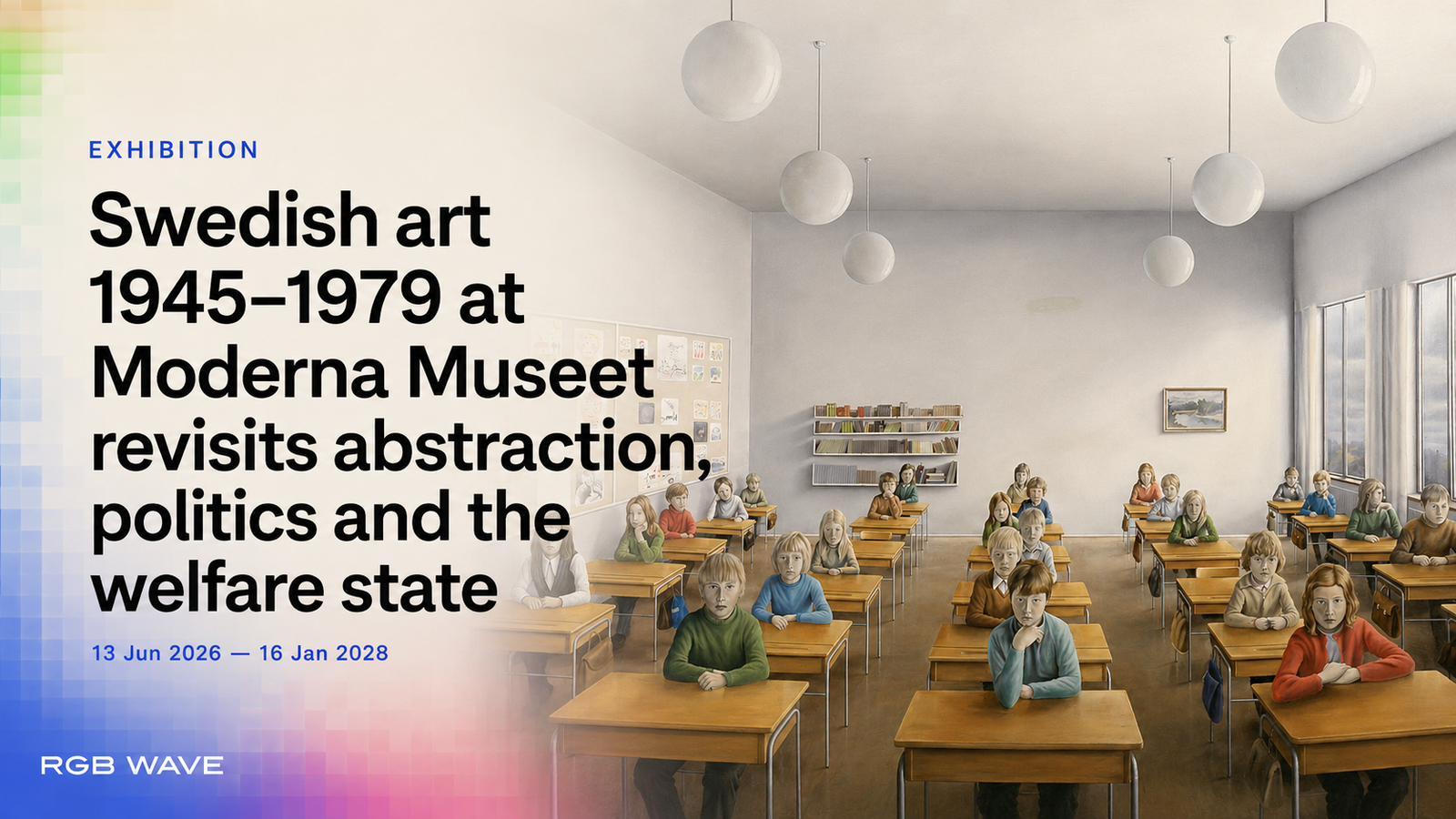
The title of the exhibition comes from Peter Tillberg’s painting Will You Be Profitable, My Friend?, a work that continues to function as a critical image of conformity and efficiency. Its question is direct, almost bureaucratic, but also deeply unsettling: what kind of subject does society want to produce?
In the context of the exhibition, the title becomes more than a reference to one painting. It frames an entire era in which the promise of collective progress existed alongside systems of measurement, discipline and social expectation. Art becomes a way to observe how individual life is shaped by public ideals.
For RGB Wave, this is where the exhibition connects strongly with contemporary visual culture. The question of profitability now belongs not only to the postwar welfare state, but also to the digital present: attention, creativity, identity and visibility are constantly measured, optimised and circulated. Readers can find more articles on contemporary art, technology and digital aesthetics on RGB Wave.
Abstraction, fiction and political commitment
The exhibition brings together a wide range of artistic approaches. Some artists explore abstraction and formal experimentation; others turn to expressive painting, fiction, inner worlds or direct political commentary. This diversity reflects a Swedish art scene that was not moving in one single direction, but negotiating multiple ways of representing a changing world.
Among the participating artists are Carl Johan De Geer, Siri Derkert, Öyvind Fahlström, Staffan Hallström, Åke Karlung, Eva Klasson, Beth Laurin, Evert Lundquist, Lennart Rodhe, Ulrik Samuelson, P O Ultvedt, Ulla Wiggen and Barbro Östlihn. Their works show how Swedish artists absorbed international influences while responding to local social realities.
That mixture is central to the exhibition’s cultural force. It does not present Swedish art as isolated or provincial, but as part of a broader postwar visual conversation about modernity, politics, technology, fantasy and the role of the institution.
Mechanical imagination and the image of the system
A central work in the exhibition is P O Ultvedt’s newly renovated Manhattan Twenty Years Later (1963–1983), a mechanical installation with motors and a coin slot. Ultvedt’s practice often brought together humour, movement, objects and critique, transforming ordinary materials into strange mechanical dramas.
His work is especially important for RGB Wave because it links postwar art to questions of automation, interactivity and technological imagination. Long before digital interfaces became dominant, artists were already thinking about systems, mechanisms and spectatorship. Ultvedt’s mechanical language suggests that modern life could be understood not only through images, but through devices.
Moderna Museet has also contextualised Ultvedt’s broader practice in relation to experimental objects, mobiles and rebellious approaches to convention through its dedicated P O Ultvedt exhibition archive. In this new collection display, that mechanical imagination becomes part of a larger postwar map.
A collection exhibition about social memory
Will You Be Profitable, My Friend? is not only an exhibition about a historical period. It is also a reflection on how a museum collection can be reactivated. Many of the works have played important roles in Moderna Museet’s exhibition history since the museum opened in 1958, making the show both a rediscovery and a re-reading.
The exhibition invites different generations to encounter the same works from different positions. Older visitors may revisit familiar images; younger audiences may see them for the first time. In both cases, the question remains active: how do artworks preserve the tensions of their time, and how do those tensions return under new conditions?
By placing abstraction, politics, mechanical art and social critique together, Swedish art 1945–1979 appears as a field of visual experimentation shaped by both hope and pressure. The result is not a nostalgic portrait of the welfare state, but a sharper image of how art responds when society tries to design the future.