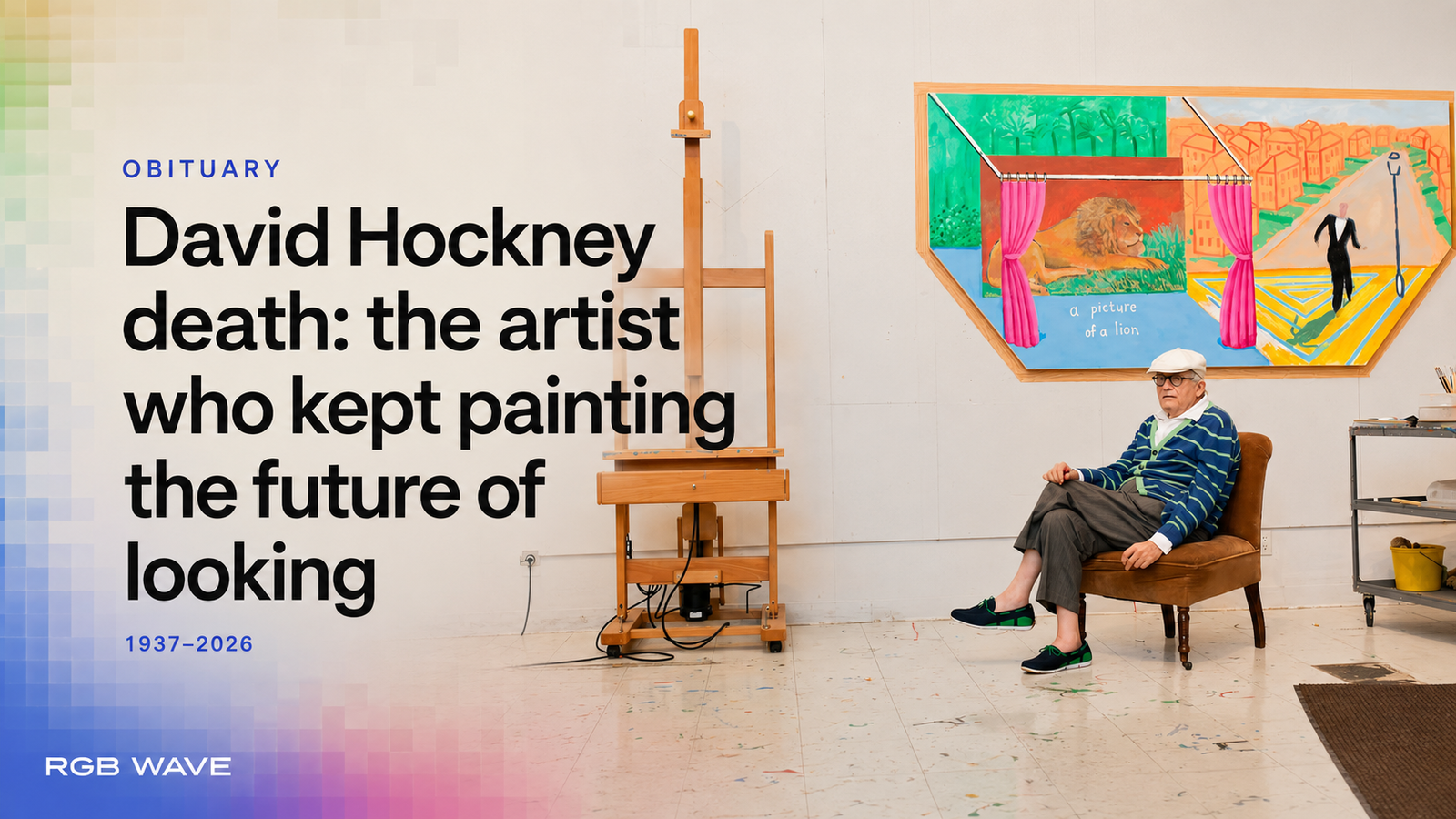
David Hockney death marks the end of a six-decade career that reshaped figurative painting, queer visibility, digital image-making and the way contemporary culture looks at the world.
David Hockney, the British artist whose luminous paintings, portraits, pools, photo-collages and digital drawings changed the language of contemporary art, died on June 11, 2026, at his home in London. He was 88. His death closes one of the most influential careers in postwar visual culture: a body of work that moved from Bradford to Los Angeles, from canvas to Polaroid, from stage design to iPad painting.
For RGB Wave, Hockney’s importance is not only historical. His work speaks directly to the present because it asks how images are built, how vision is structured and how technology changes the act of looking. Long before “visual culture” became a common phrase, Hockney was already treating painting, photography, print, fax, photocopy, video and digital tools as part of a single, restless investigation into perception.
A figurative artist against the dominant abstraction
Born in Bradford, Yorkshire, in 1937, Hockney emerged at a moment when abstraction still carried enormous institutional authority. His early paintings helped return attention to the figure, narrative, domestic space and everyday desire. Rather than following the dominant seriousness of mid-century abstraction, he built an art of bodies, rooms, swimming pools, friends, lovers, parents and landscapes.
His relationship with Los Angeles became one of the central myths of his career. After visiting the city in the 1960s, Hockney developed a visual language that transformed Southern California into a world of flat colour, clean architecture, suspended water and emotional distance. Works such as A Bigger Splash turned the swimming pool into one of the most recognisable images of modern leisure, but also into a scene of absence: a splash without a visible body, a moment after impact.
Queer intimacy as everyday life
One of Hockney’s most radical contributions was his treatment of gay life not as coded subtext, but as visible experience. At a time when open representations of same-sex desire remained socially and politically charged, his work presented male intimacy, longing and domestic tenderness with disarming directness.
This was not always framed as declaration or activism. Often, Hockney’s paintings and drawings made queer life appear as part of the ordinary emotional texture of the world: a lover by a pool, a figure in a room, a portrait shaped by affection and distance. That calm visibility gave the work a lasting political force, precisely because it refused to separate desire from daily life.
From Polaroid grids to digital vision
Hockney’s fascination with technology was never a late-career novelty. In the 1970s and 1980s, he began using photography not only as reference but as a way to challenge single-point perspective. His Polaroid composites and photo-collages broke scenes into multiple viewpoints, producing images that felt closer to memory, movement and embodied vision than to the frozen authority of the camera.
This rejection of a single fixed viewpoint connected Hockney to Cubism, Chinese scroll painting and his own resistance to the idea that photographic realism was the natural endpoint of image-making. For him, the eye moved; therefore, the image should move too. This idea would later return in his multi-screen videos, digital drawings and iPad works, many of which can be explored through the artist’s official archive of iPad works.
In this sense, Hockney anticipated a world in which images are no longer stable objects but fluid interfaces. His career connects analogue collage to digital screens, painting to software, and observation to technological experimentation. Readers interested in how artists continue to transform the systems through which images circulate can find more articles on contemporary art, technology and digital aesthetics on RGB Wave.
The market, the museum and the public image
Hockney became one of the rare artists able to move across popular recognition, institutional respect and market power. His 1972 painting Portrait of an Artist (Pool with Two Figures) sold at Christie’s in 2018 for more than $90 million, becoming at the time one of the most visible symbols of his market stature.
But Hockney’s cultural presence was never reducible to auction prices. His work remained deeply public because it reproduced well, circulated widely and felt immediately readable without becoming simple. A Hockney image could appear in a museum, a book, a poster, a newspaper, a screen or an Instagram feed and still retain its graphic clarity.
Major exhibitions continued to define his later life. The 2025 exhibition David Hockney 25 at Fondation Louis Vuitton brought together hundreds of works and confirmed the scale of his late institutional presence. In London, Serpentine also presented his recent Normandy works in 2026, reinforcing how active his final years remained.
A legacy built on looking again
Hockney’s legacy lies in his refusal to accept that any medium had the final word on vision. Painting was not replaced by photography. Photography was not replaced by digital drawing. The iPad did not cancel the sketchbook. Instead, each tool became another way to ask the same question: how do we see, and how can art make that act visible?
That question explains why Hockney remains relevant to a culture shaped by screens, filters, image feeds and accelerated visual consumption. His work reminds us that technology does not automatically make vision more advanced. It only becomes meaningful when an artist uses it to sharpen attention.
David Hockney’s death marks the end of a life spent looking with unusual intensity. His images endure because they are bright without being superficial, intimate without being private, technological without losing touch with the hand. In a century of restless image circulation, Hockney’s lesson remains direct: to look is not passive. It is a way of making the world.